
Free Trading Journal: Track Your Trades, Analyze Your Performance & Improve Your Trading for Free
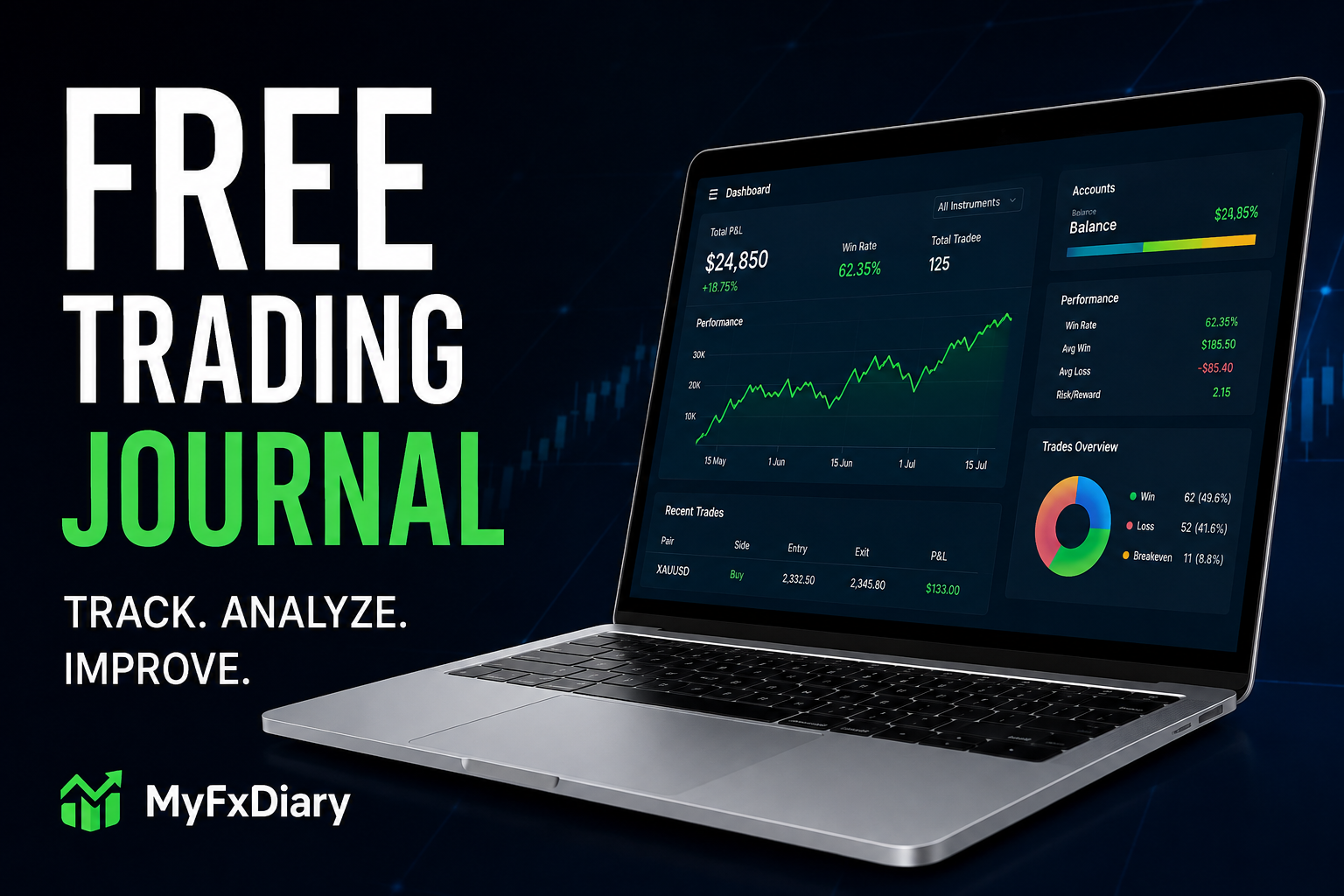
If you are serious about becoming a better trader, one habit can make a bigger difference than constantly searching for a new strategy: keeping a trading journal.
Whether you trade Forex, Gold, Stocks, Crypto, Futures, or CFDs, a trading journal helps you record what you did, why you did it, what happened, and—most importantly—what you can learn from it.
The problem is that many traders still use scattered Excel sheets, handwritten notebooks, screenshots, or expensive trading journal software.
But you don't necessarily need to pay to start.
Today, there are online platforms that allow traders to create and maintain a free trading journal without building complicated spreadsheets from scratch.
One such platform is MyFxDiary, which provides traders with a free way to record trades, track performance, analyze mistakes, and build better trading habits.
What Is a Trading Journal?
A trading journal is a record of your trades and the decisions behind them.
It can contain information such as:
-
Entry price
-
Exit price
-
Stop loss
-
Take profit
-
Position size
-
Risk-to-reward ratio
-
Profit or loss
-
Trading setup
-
Market conditions
-
Trade screenshots
-
Emotions
-
Mistakes
-
Reasons for entering and exiting a trade
But a good trading journal is more than a list of numbers.
It should help answer questions like:
Why am I losing trades?
Which setups actually work for me?
Do I make more mistakes after a loss?
Am I following my trading plan?
Which market, session, or setup produces my best results?
This is where journaling becomes a performance-analysis tool rather than simply a trade log.
Why Do Traders Need a Trading Journal?
Most traders remember their winning trades.
They often remember their biggest losses too.
But they usually don't remember the hundreds of small decisions that created those results.
That's a problem.
Without proper records, it is easy to say:
"My strategy doesn't work."
when the real problem might be:
-
entering too early,
-
moving stop loss,
-
taking revenge trades,
-
overtrading,
-
closing winners too soon,
-
ignoring trading rules,
-
trading outside the planned session,
-
risking too much after a loss.
A trading journal turns these assumptions into data.
Instead of guessing what is wrong with your trading, you can review your actual history.
What Is a Free Trading Journal?
A free trading journal is an online or software-based journal that allows you to record and analyze your trades without paying a subscription fee.
However, there is an important difference between:
Free Trial
and
Free Trading Journal.
A free trial may give you access for a limited number of days before requiring payment.
A free plan may restrict the number of trades or certain features.
A genuinely free journal provides usable functionality without requiring payment for basic journaling.
Therefore, when choosing a free trading journal, don't look only at the word "free."
Check:
-
How many trades can you record?
-
Are analytics included?
-
Can you track mistakes?
-
Can you add screenshots?
-
Is performance analysis available?
-
Is your trading data private?
-
Does the free plan expire?
-
Are important features locked behind payment?
Best Free Trading Journal for Traders
If you are looking for a free trading journal website, the most important thing is not simply the price.
The platform should make journaling easier than using a spreadsheet.
A useful online trading journal should allow you to:
1. Record Your Trades
Every trade should be documented instead of relying on memory.
2. Track Profit and Loss
You should be able to understand how your trading account is performing over time.
3. Analyze Your Performance
Your journal should help you identify patterns in your trading results.
4. Record Trading Psychology
Your emotions can have a major influence on execution.
Recording emotions such as fear, FOMO, hesitation, or revenge trading can help reveal behavioral patterns.
5. Track Mistakes
A loss is not always a bad trade.
Sometimes a losing trade followed the plan perfectly.
Sometimes a profitable trade was actually a bad decision.
A good journal helps you distinguish between trade outcome and trade quality.
MyFxDiary — A Free Online Trading Journal
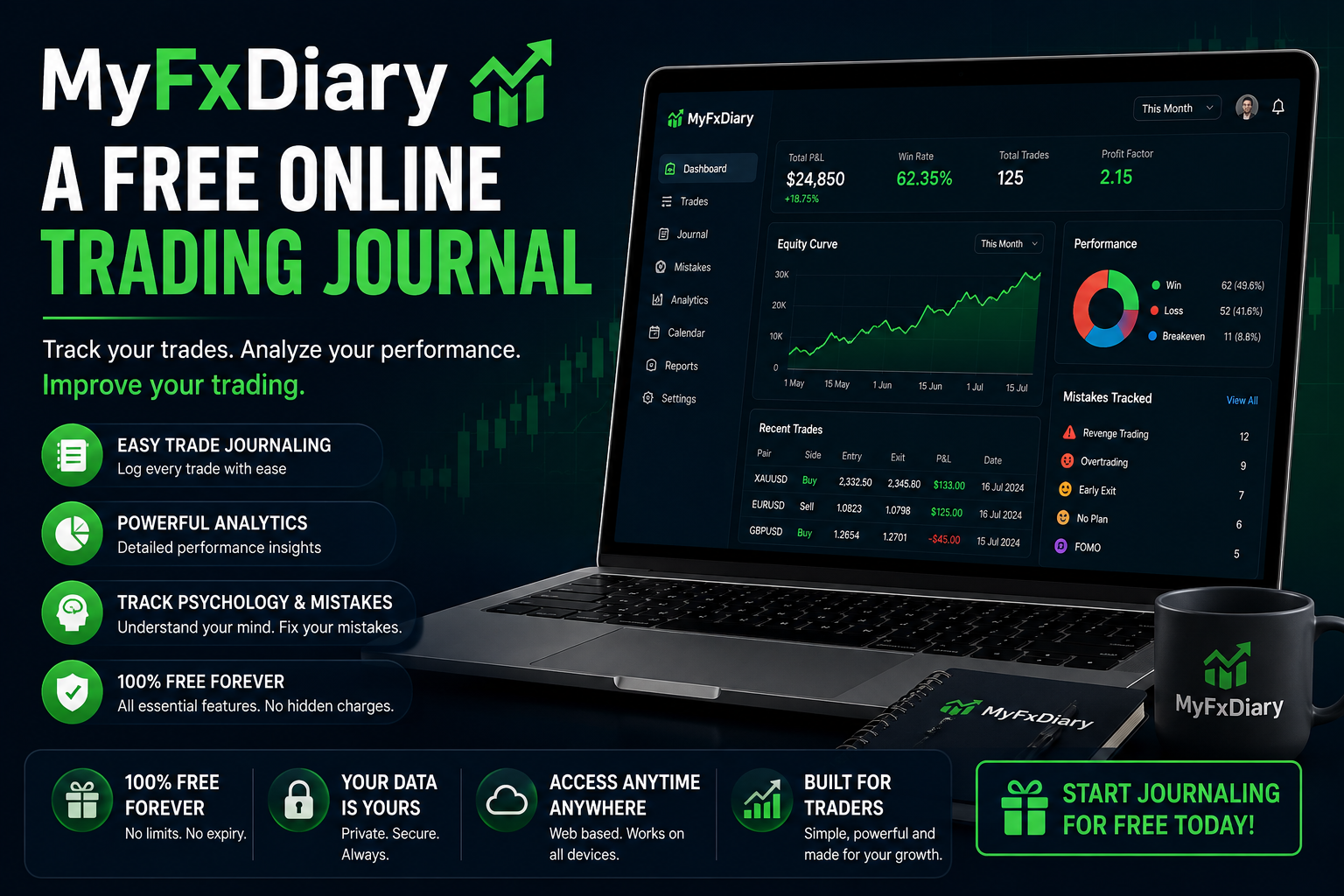
MyFxDiary is built to make online trade journaling simple for traders who want to record, analyze, and improve their trading.
The platform currently offers a Free Forever plan for traders who want to start journaling without paying for a subscription.
You can use it to record your trades and organize important information about each setup.
The platform also focuses on areas that many traders ignore, including trading psychology and mistakes.
For example, traders can record mistakes such as:
-
FOMO
-
Revenge Trading
-
Early Exit
-
Poor Entry
-
Overtrading
-
Rule Violation
The purpose is simple:
Don't just record what happened. Find out why it happened.
What Can You Track in a Trading Journal?
A professional trading journal should allow you to look at your trading from multiple perspectives.
Trade Performance
Track:
-
Total trades
-
Winning trades
-
Losing trades
-
Profit
-
Loss
-
Win rate
-
Average result
-
Risk-to-reward
-
Equity growth
These numbers help you understand the overall performance of your trading.
Trading Setup
Record the strategy or setup used for every trade.
After collecting enough data, you can compare different setups.
For example:
Setup A: 62% win rate
Setup B: 41% win rate
Setup C: 55% win rate
Now you have something much more useful than a feeling.
You have data.
Trading Psychology
Your mindset matters.
Before entering a trade, you may feel confident.
After a losing trade, you may feel frustrated.
After several wins, you may become overconfident.
Recording these emotions can reveal patterns that are difficult to notice while trading live.
Free Forex Trading Journal
Forex traders can benefit significantly from maintaining a journal because the same currency pair can produce very different results depending on the setup, session, market condition, and execution.
A free Forex trading journal can help you track:
-
Currency pairs
-
Buy/Sell direction
-
Entry and exit
-
Stop loss
-
Take profit
-
Position size
-
Risk
-
Profit/Loss
-
Trading session
-
Strategy
-
Market conditions
-
Emotions
-
Mistakes
For example, you might discover that your strategy performs well during the London session but poorly during low-volume periods.
Without a journal, that pattern may remain hidden.
Free Gold Trading Journal
Gold traders can also benefit from detailed journaling.
XAU/USD can move quickly, which makes execution and risk management especially important.
A gold trading journal can help you review:
-
Entry timing
-
Stop-loss placement
-
Risk per trade
-
Session
-
Setup
-
News conditions
-
Emotional state
-
Trade management
-
Profit and loss
After enough trades, you may discover patterns such as taking too many trades after a stop loss or entering Gold trades without waiting for confirmation.
That information can become extremely valuable.
Trading Journal for Beginners
If you're a beginner, you don't need a complicated system.
Start with the basics.
For every trade, record:
What did I trade?
Why did I enter?
Where was my stop loss?
Where was my target?
How much did I risk?
What happened?
Did I follow my rules?
What could I have done better?
That's enough to start.
The biggest mistake beginners make is trying to create the perfect journal instead of actually maintaining one.
Consistency matters more than complexity.
Trading Journal vs Excel Spreadsheet
Excel and Google Sheets can absolutely be used as trading journals.
They are flexible and inexpensive.
But building a complete trading journal manually can become complicated.
You may need to create:
-
formulas,
-
dashboards,
-
charts,
-
filters,
-
performance calculations,
-
win-rate calculations,
-
equity curves,
-
mistake categories,
-
monthly reports.
An online trading journal can simplify much of this process.
Instead of spending hours designing the spreadsheet, you can spend that time reviewing your actual trades.
That is the real advantage of using a dedicated trading journal website.
How to Use a Trading Journal Correctly
Having a journal is not enough.
You have to use it consistently.
Step 1: Record the Trade
Enter the important details immediately after the trade or according to your journaling routine.
Don't rely on memory.
Step 2: Record Your Reason
Write down why you entered.
This is extremely important.
Later, you can compare your original reasoning with what actually happened.
Step 3: Record Your Emotions
Were you:
-
Calm?
-
Fearful?
-
Excited?
-
Impatient?
-
Angry?
-
Confident?
-
FOMO-driven?
Be honest.
The journal is for you—not for impressing anyone.
Step 4: Mark Your Mistakes
If you broke a rule, record it.
Don't hide it.
A mistake that is properly recorded can become a lesson.
Step 5: Review Your Trades
This is the most important step.
Journaling without reviewing is like collecting data without reading it.
At the end of the week or month, analyze your results.
Ask:
What worked?
What didn't work?
Which mistakes repeated?
Which setups performed best?
Where did I lose money unnecessarily?
Your Trading Journal Should Answer One Important Question
There is one question every trader should eventually be able to answer:
"What exactly is making me money or losing me money?"
Not:
"I think this strategy works."
Not:
"I feel like I trade better in the morning."
Not:
"I probably lose because of psychology."
You want evidence.
Your trading journal should help convert:
Opinion → Data → Pattern → Decision → Improvement
That is the real purpose of journaling.
Why Trading Psychology Belongs in Your Journal
Many traders focus almost entirely on technical analysis.
They study:
-
Market structure
-
Indicators
-
Price action
-
Support and resistance
-
Liquidity
-
Breakouts
-
Supply and demand
But then they ignore what happens inside their own mind.
A trader can have a profitable strategy and still lose money because of:
FOMO.
Revenge trading.
Overtrading.
Fear of taking a valid setup.
Moving stop loss.
Taking profits too early.
A trading journal gives you a place to identify these behaviors.
Over time, you may discover that your biggest problem isn't your strategy.
It is your execution.
What Makes a Good Free Trading Journal?
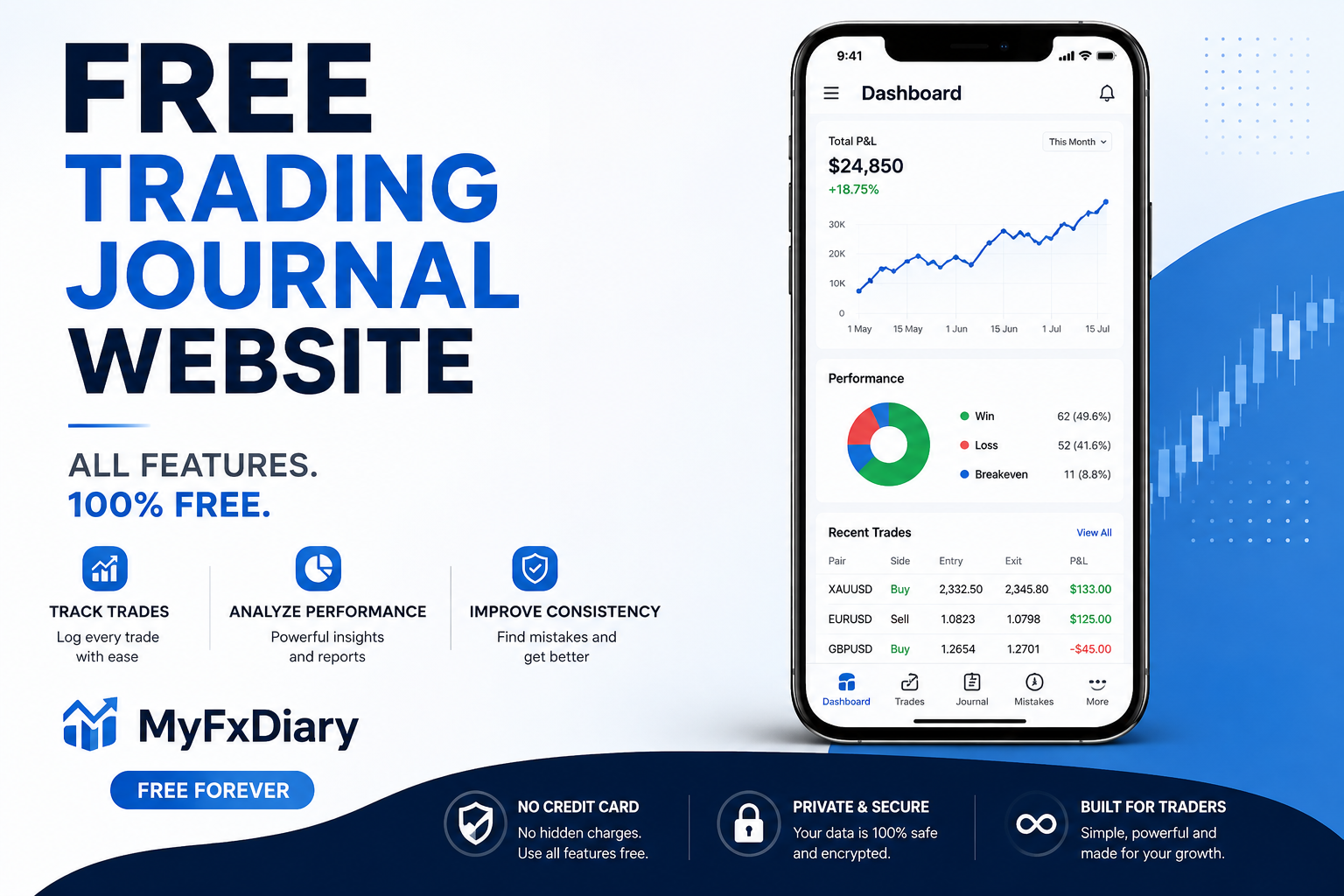
Before choosing any platform, look for these qualities.
Easy to Use
If entering one trade takes too long, you may eventually stop journaling.
Useful Analytics
The journal should help you understand your performance, not just store information.
Psychology Tracking
Your emotions and mistakes are part of your trading performance.
Screenshot Support
Charts and screenshots can provide valuable context during trade review.
Performance History
You should be able to look back at your trading journey.
Privacy
Your trading information should be handled responsibly.
No Unnecessary Complexity
A journal should help your trading process—not become another task that overwhelms you.
Is a Free Trading Journal Enough?
For many traders, yes—especially when the goal is to build the journaling habit.
You don't need expensive software to answer the fundamental questions:
Am I following my strategy?
Am I managing risk properly?
Which setups work?
What mistakes keep repeating?
Is my execution improving?
Start with the tools you actually need.
You can always add complexity later.
The most important thing is to start recording your trades consistently.
Who Should Use a Free Trading Journal?
A free trading journal can be useful for:
-
Forex traders
-
Gold traders
-
Stock traders
-
Crypto traders
-
Futures traders
-
Day traders
-
Swing traders
-
Scalpers
-
Prop firm traders
-
Beginner traders
-
Experienced traders
You don't need to be profitable before starting a journal.
In fact, journaling can be even more valuable while you're still learning.
Start Your Trading Journal for Free
If you've been searching for a free trading journal, free trading journal website, or free Forex trading journal, you don't need to wait until you're a professional trader.
Start with your next trade.
Record it.
Review it.
Learn from it.
Then repeat.
MyFxDiary provides a Free Forever option for traders who want to start building this habit online.
Instead of keeping your trading history scattered across screenshots, notebooks, and spreadsheets, bring your trades into one organized journal and start learning from your own data.
Your next trade is not just another trade.
It's another piece of data about the trader you're becoming.
Start your trading journal with MyFxDiary and turn your trading history into something you can actually learn from.
Frequently Asked Questions
What is the best free trading journal?
The best free trading journal is one that allows you to consistently record and review your trades while providing the performance information you actually need. Features, trade limits, analytics, psychology tracking, and ease of use should all be considered before choosing a platform.
Is MyFxDiary free?
Yes. MyFxDiary currently offers a Free Forever plan for traders who want to start journaling without paying for a subscription.
Is there a free Forex trading journal?
Yes. Traders can use online trading journal platforms to record Forex trades, analyze performance, and review their trading behavior without necessarily paying for a premium subscription.
Can I use a trading journal for Gold?
Yes. A trading journal can be used to track Gold/XAUUSD trades, including entry, exit, risk, setup, stop loss, profit/loss, emotions, and mistakes.
Is Excel good for a trading journal?
Excel can be a useful starting point, but building advanced analytics and maintaining formulas manually can become time-consuming. A dedicated online trading journal can simplify the process.
Should beginners use a trading journal?
Absolutely. Beginners can benefit from journaling because it creates a record of their decisions and helps them identify repeated mistakes and patterns.
What should I write in a trading journal?
At minimum, record the instrument, direction, entry, exit, stop loss, target, position size, result, setup, reason for entry, emotions, and any mistakes.
How often should I review my trading journal?
You can review individual trades after execution and perform a deeper review weekly or monthly. The important thing is consistency.
Can a trading journal make me profitable?
A trading journal cannot guarantee profitability. What it can do is give you better information about your decisions, performance, risk management, and recurring mistakes so you can make more informed improvements.
Final Thought
A trader who doesn't record their trades is often forced to learn from memory.
A trader who journals can learn from data.
Your strategy may change.
Your market may change.
Your account size may change.
But one habit can stay the same:
Record. Review. Learn. Improve. Repeat.
Start your trading journal today—for free.
